
Once your pregnancy is confirmed at a clinic in Japan, the next required step is to register your pregnancy at city hall.
This process unlocks essential support, including the Maternal and Child Health Handbook, prenatal checkup subsidies, and postpartum services.
This article explains what pregnancy registration is, when and where to do it, what actually happens at the counter, and what you receive, so you can complete the process with confidence.
1. What Is Pregnancy Registration in Japan?

Pregnancy registration is a formal notification to your local municipality that you are pregnant.
Unlike systems where pregnancy care is handled only by hospitals, Japan’s maternity care is coordinated through local governments. By registering your pregnancy, the city can:
- issue official maternity documents
- provide financial support for prenatal checkups
- arrange health guidance and home-visit services
Pregnancy registration is not optional if you plan to give birth and raise your child in Japan. Without registering, you cannot receive the Maternal and Child Health Handbook or prenatal checkup coupons.
2. When and Where to Register

Most people register their pregnancy after a doctor confirms the baby’s heartbeat, usually around 6-9 weeks of pregnancy.
At this stage, the clinic issues a pregnancy certificate. You must submit it to the city, ward, or town where you are officially registered as a resident.
When you arrive at the city hall, look for the Maternal and Child Health section. Some municipalities require advance reservations, while others accept walk-ins.
Check your city’s official website using keywords such as “Pregnancy registration.”
3. What Happens at the Counter

The entire process usually takes 30-60 minutes, depending on the city and whether a short interview is included.
What to bring
- Pregnancy certificate
- Residence card
- My Number card (if you have one)
- Basic personal information (address, phone number, due date)
Step-by-step process
- You fill in a short registration form.
- You submit the pregnancy certificate.
- Staff confirm your contact details and due date.
- You receive several important items and explanations.
Staff may ask simple questions such as:
- Is this your first pregnancy?
- Do you have a hospital or clinic in mind for delivery?
- Do you have any health concerns?
These questions are asked to help the city provide appropriate support, not to judge or screen you.
4. What You Receive
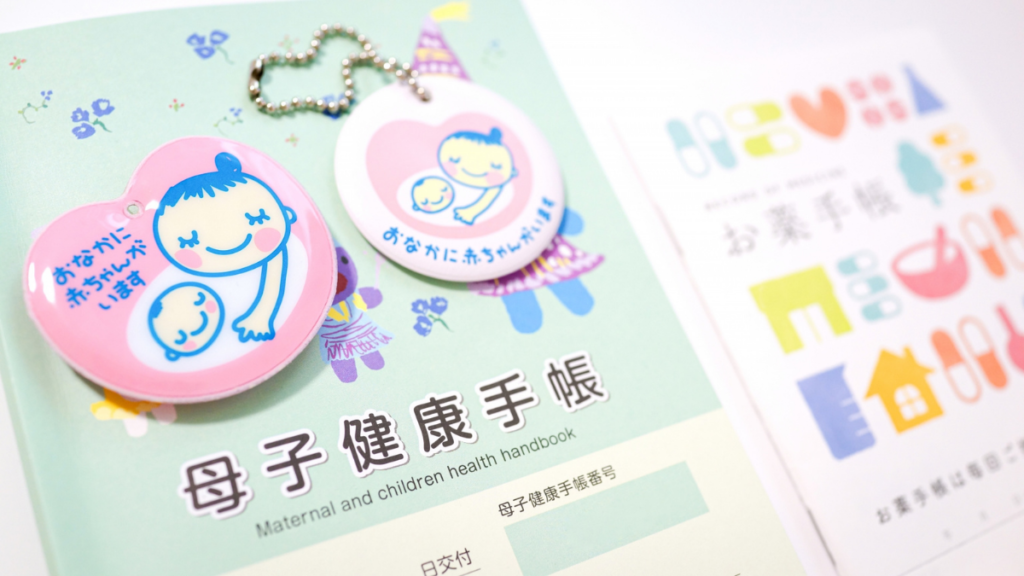
After registration, you will receive several important items. Contents vary slightly by city, but typically include the following.
Maternal and Child Health Handbook
It records:
- prenatal checkups
- test results and ultrasound notes
- labor and delivery information
- your child’s growth from birth to around age 6
- vaccinations and regular health checkups
You will use this booklet for years, so keep it safe and bring it to every checkup. Some municipalities (for example, Kyoto City) provide multilingual versions.
Prenatal and Postnatal Checkup Coupons
These coupons reduce the cost of prenatal checkups (usually about 14 visits).
You present them at the clinic and pay only the remaining amount. Coverage varies by city.
Birth Notification Postcard
This is used after delivery to notify the health center of your baby’s birth. This postcard helps the city schedule services such as newborn checkups, breastfeeding support, and guidance for new parents.
Other Materials
Depending on the city, you may also receive below.
- vaccination pre-check forms
- information on parenting classes
- contact numbers for consultation services
- guidance on home-visit support
5. Common Mistakes & FAQs
“I registered late. Is that a problem?”
There is no strict deadline, but registration by around 11 weeks of pregnancy is recommended. Late registration is usually accepted – contact city hall as soon as possible.
“I forgot a document.”
In many cases, staff will let you return later with missing documents. Call ahead to confirm.
“Can my partner register for me?”
Some cities allow this if documents are complete, but many prefer the pregnant person to attend, especially for health guidance.
Language support at city hall
Language support varies by municipality. Some cities offer multilingual pamphlets, interpreter dispatch services or phone interpretation.
6. Useful Links & Next Step
Once pregnancy registration is complete, the next step is regular prenatal checkups and birth preparation.
Useful Links (Official & Trusted)
- Mother’s Tree Japan Official LINE
Multilingual support via official LINE account. Families can consult pediatricians and midwives directly in 13 languages. - Maternal & Child Health Interpreter Consultation (SHARE)
Multilingual support for communicating at clinics and hospitals. - AMDA Medical Information Center
Helps you find clinics and hospitals with foreign-language support